What Is The Relationship Between Adding Fractions And Multiplying
Fractions
What Is The Relationship Between Adding Fractions And Multiplying Fractions. Pupils multiply a proper fraction by a whole number (greater than a whole) 5. The top number — called the numerator — tells you the.
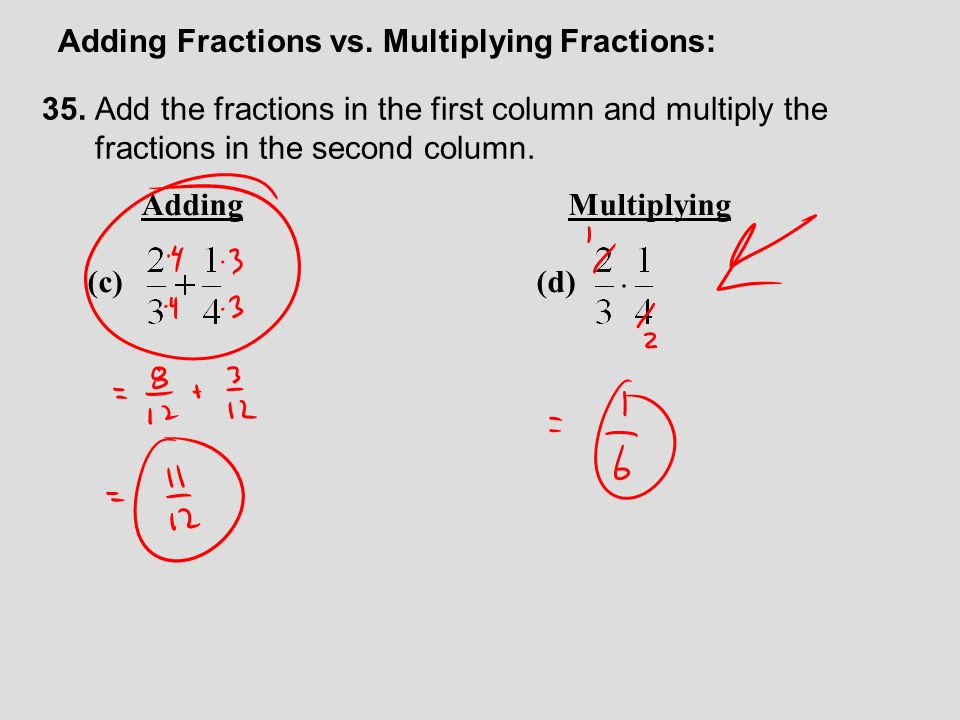
Operations With Positive Fractions - Ppt Download from slideplayer.com
Make the dividend greater than the numerator by placing 0 next to the digit and to the quotient. There is an inverse relationship between the number of parts and the size of each part: Dividing fractions is equivalent to multiplying by a reciprocal.
The Second Is That When Two Fractions Less Than One Are Multiplied, The Product Is Always Less Than Either Factor.
Pupils multiply a proper fraction by a whole number (within a whole) 4. Anything sitting on top of the fraction gets multiplied together. Dividing fractions is equivalent to multiplying by a reciprocal.
Demonstrate The Relationship Between The Repeated Addition Of Fractions And The Multiplication Of That Fraction By A Whole Number Solve Problems Involving Fractions
The quick and dirty tip is to multiply all of the numerators of the fractions in your problem together to obtain the numerator of the resulting fraction, and to multiply all of the denominators of the fractions in your problem together to obtain the denominator of the resulting fraction. This becomes the numerator of your answer. Explaining why multiplying a given number by a fraction less than 1 results in a product smaller than the given number;
When It Comes To Multiplying And.
Add fractions with unlike denominators) by replacing given fractions with equivalent fractions. (5.nf.1) subtract fractions with unlike denominators by One important thing to remember is that multiplication of a fraction by a whole number is the same as repeated addition of a unit fraction for example, 2 x (1/4) = 1/4 + 1/4.
Pupils Multiply A Proper Fraction By A Whole Number (Greater Than A Whole) 5.
Equivalence of fractions to develop algorithms for adding, subtracting, multiplying, and dividing fractions. You just multiply the numerators and multiply the denominators, then reduce if. So, for a problem like 1/8 x 3/5, the numerator of the resulting fraction is given by 1x3.
But Another Way To Express That Same Relationship Is To Say, All Right, If Three Times Six Is 18, Then If I Were To Start With 18 And Divide It By Three, That Would Be Equal To Six.
There is an inverse relationship between the number of parts and the size of each part: This is true for unit fractions (fractions with a numerator of one). For example, 1/2 x 1/4 is interpreted as 1/2 of 1/4.