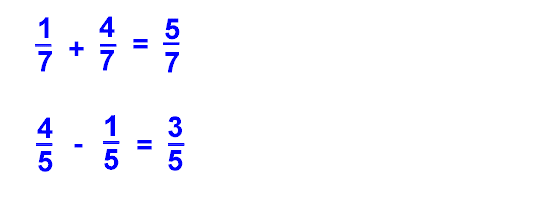
What Does Adding Fractions Mean. + = +, so + = + =. Although students are focusing on adding and subtracting fractions in this activity, many of them will have noticed that the repeated addition and subtraction is also multiplication and division.
Kids Math: Adding And Subtracting Fractions from www.ducksters.com
The difference between 6 and 3 is 3. Why does this rule work? In none of these cases does and show an operation.
Adding Similar Fractions Means Adding Fractions With The Same Denominator.
Although students are focusing on adding and subtracting fractions in this activity, many of them will have noticed that the repeated addition and subtraction is also multiplication and division. In order to bring them to the same denominator, we need to change all of the existing denominators while at the same time changing the numerator such that the fractions. This is done for expediency.
You Know How To Add, But What Does Add Mean?
The addition of fractions, meanwhile, involves assuming that the “whole” in the context is whatever it is we have a fraction of. The addition of fractions is a little different from the normal addition of numbers since a fraction has a numerator and a denominator which is separated by a bar. $$\frac{a}{b}$$ where a is called the numerator and b is called the denominator.
Fractions Are Used To Represent A Part Of A Whole.
Divide the line into n equal parts where n is the denominator of the fraction. The difference between 6 and 3 is 3. The sum of 2 and 2 is 4.
Then, Convert The Answer To Lowest Term Or Mixed Number.
2 x 2 = 4. It is very normal to add two numbers such as a + b or b + a. Why does this rule work?
Adding Fractions Means To Add One Fraction With The Other.