How Do You Estimate Division Problems. After you subtract, you should get an estimated answer of 120. The estimate and the exact answer will usually have the same number of digits.
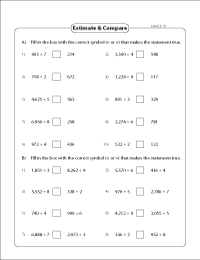
Estimating Products & Quotients Worksheets from www.mathworksheets4kids.com
70 has only 1 significant figure so tables will be able to be used in the next step.) write 1 327 ÷ 70 on the board and discuss what 1 327 could be rounded to. A fraction with 50 parts (17/50+33/50) can be expressed by separating 50 pieces into two groups. What is 0.3126 times 53.81.
Long Division Calculator With Step By Step Work For 3Rd Grade, 4Th Grade, 5Th Grade And 6Th Grade Students To Verify The Results Of Long Division Problems With Or Without Remainder.
To solve a word problem using repeated subtraction, students start with the number being divided up or the dividend. Estimating very difficult problems let me give you another problem and a slightly different approach to it using what you already know. Division problems ask how many copies of something we can have if we distribute a number equally.
Other Types Of Problems One Can Solve By Estimating Are:
If we take off the five zeros, we get 1x2=2; Multiply 0.3 × 50 to get 15. Estimation of the division of decimals:
Putting Them Back On, We See That The Answer Is About 200,000!
If there’s a remainder, it will be written as a. Now they subtract the divisor or the number that tells how many groups are needed from the dividend over and over until they reach zero. Your estimated answer will be 4,800.
You Can Use Multiplication To Check Your Division Answer This Way.
Check division with multiplication division and multiplication are inverse or opposite operations. A fraction with 50 parts (17/50+33/50) can be expressed by separating 50 pieces into two groups. You can figure out how much you need to add to 6 by subtracting 90 from 123.
Round 56 To 60 And 81 To 80, And Then Multiply.
Multiply the quotient times the divisor. You multiply your answer from step 1 and your divisor: To calculate how many slices each person gets, we use division: