How To Reduce Mixed Fractions Examples
How To Reduce Mixed Fractions Examples. In order to simplify a mixed fraction, you need to simplify the fractional part only. Convert the mixed fraction percent into a proper fraction;
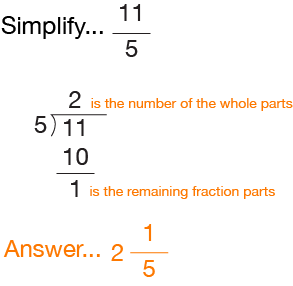
One of the concepts that is central to working with fractions in math is that as long as you perform the same operation on both the numerator (top) and denominator (bottom), you won't change the underlying value of the fraction. In our example, the antecedent term of the ratio is the mixed fraction 1 5/12, so we first need to convert this to an improper fraction (if there are no mixed fractions in the ratio, you can skip this step). The resultant will be the new numerator and the new denominator of the mixed fraction.
While Reducing A Mixed Number To The Simplest Form, We Reduce The Fraction Part And Not The Whole Number.
Keep (leave the first fraction the same) — change (change the division symbol to multiplication) — flip (take the reciprocal of the second fraction) to help, let’s shine a light on a few problems. Improper fractions and mixed fractions are interchangeable. Some examples of complex fractions are:
Subtracting A Fraction From A Whole Number.
Other examples of fully reduced fractions include 7/8, 5/9, and 11/20. For example, if you begin the fraction 1/2, and multiply the top and bottom of the fraction by, say 5, you will not change the underlying value of. Therefore, from the above example, we can observe, by multiplying two fractions we get a fraction number.
Multiply The Numerators Of The Fractions.
For that write the numerator and the denominator in factored form and cancel out the common factors. Reducing fractions to lowest terms examples. In the given fraction, both numerator and denominator are divisible by 3.
Now Multiply The 1/100 To Remove The Percent Symbol;
In the following picture, 2 1 4 = 9 4 , as shown here. In the given fraction, both numerator and denominator are divisible by 8. Another way in which mixed fractions can be reduced is by keeping the whole number separate and reduce only the fractional part of the mixed fraction.
The Resultant Will Be The New Numerator And The New Denominator Of The Mixed Fraction.
To convert a mixed fraction into improper fraction first we multiply the denominator of the proper fraction to the whole number attach with it and then we add the numerator. In our example, the antecedent term of the ratio is the mixed fraction 1 5/12, so we first need to convert this to an improper fraction (if there are no mixed fractions in the ratio, you can skip this step). Multiply a fraction and a whole number: